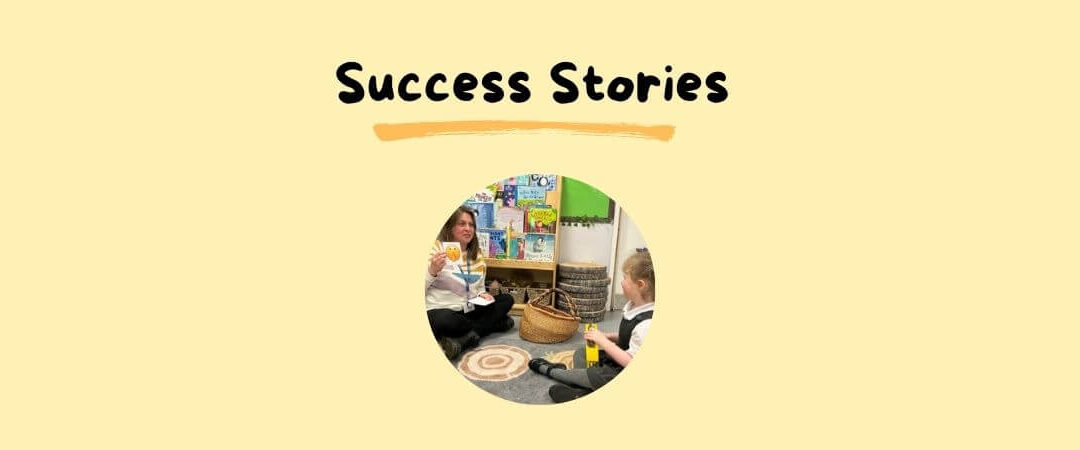
Donna Wilson-Smith, Headteacher at St Oswald’s Church of England Primary School and Nursery and a former Sounds-Write Literacy Specialist, shares with us how they have been using Sounds-Write in the nursery to get children ready to start their literacy journey.
Tell us a bit about the nursery.
Ours is a governor-led nursery, staffed by level three early years educators. We employ about 15 staff, most of them part-time, experienced practitioners, and we have a team of three managers that lead on planning and teaching. Numbers vary but we have approximately 30 children in every day. It is an extended provision nursery, open 7:45 to 18:00 during term-time and also as a holiday club, and children have a variety of attendance patterns. We always tell prospective parents that phonics is important to us and that we will begin phonics in nursery, to get children ready for Reception.
When they come in the morning, the children settle into activities and then twice a day there’s group time, which will have a specific focus, maybe maths, art or phonics. This means they will spend quality time with a key person, sitting in a circle as they are working on the planned activity.

We prefer it when the adult models the writing rather than print being there already, because that gives the children the idea that it’s something they could do too.
Donna Wilson-Smith, Headteacher
How do you introduce Sounds-Write in nursery?
We’d been a Sounds-Write school since before Covid, and in 2021 we decided to introduce Sounds-Write in our nursery. We started in the autumn term with exploration of sounds in the environment, percussion… From January we began introducing oral phonics, segmenting and blending sounds orally. And after Easter, we moved to more formal phonics.
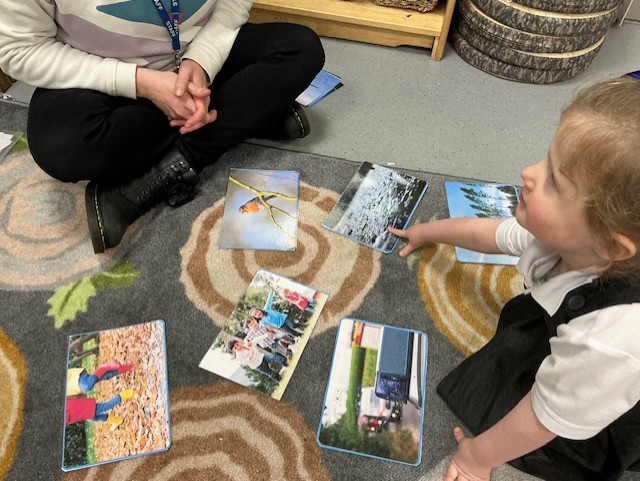
We worked with Sounds-Write on writing and piloting the current ‘Sounds-Write in the Early Years’ course, and that was really useful because it made me review the research. I realised that there is limited value in doing phonemic awareness without letters. So in the course now there is a bit of oral sound identification, segmenting and blending, but it moves very quickly to working with letters and connecting sound to print. Sounds are always presented in the context of words, even if, to start with, we use a soft toy or a picture to connect the sound to the word.
Are children ready for writing in nursery?
When it comes to writing, we like using blank sound cards, then the adult writes the spellings on them, so that it links to what they will be doing in Reception. Some of the children will be ready for writing, but others might be tracing on the soft carpet, or on shaving foam or sand in a tray. It depends on their age and readiness, and also on how long they’ve been with us, because some join when they’re two and might be with us nearly three years before they go into Reception. Those children might be quite advanced by the end of it and might be keen to do the writing or to start reading a book. The Reading Together Collection is great for them because having time with an adult reading a story is so important, and then we can say ‘Oh, will you read that word?’ and they love that they can.
What has been the impact of training nursery staff to introduce phonics?
Doing the training has given staff the confidence to think about phonics in other contexts. When the older nursery children want to write, the staff can support them by talking about the sounds in words and modelling how to write them with a simple, ‘This is how we write this sound’. This is good for children’s emergent writing. The same applies to children’s names, which are often the first entry into matching sounds and letters. Before, we might have had peg labels that started with the letter and not the sound, so for Emily it might have been a picture of an ‘ear’! Now we make sure the peg label matches the sound of their name and not the letter, so we might use ‘egg’ or ‘elephant’ for Emily.
Is it a problem in Reception if some children have done phonics in nursery and some haven’t?
Our nursery feeds into several schools. Some children stay with us, others move on to schools that might not use Sounds-Write. In either case, it’s given them a solid foundation in the basic skills and prepared them well for learning to read in Reception. And we also get some children in our Reception who have been in private day care and won’t have done Sounds-Write before. It works well because we have a group of little experts who know what’s going on, what to do with the boards, draw the lines, build the words… and can model it for the newcomers. It’s not a whole class of children who are brand new to phonics and to the routines of learning, so they pick it up really quickly because they have role models. The teacher can choose a child who has done Sounds-Write in nursery to come to the board to build a word, and it gives the others the confidence that they can do it too.
You may also like
‘Sounds-Write is a long-term, strategic commitment’: Jaspreet Bansal, Eastbury Community School
For Eastbury Community School in East London, Sounds-Write has been transformational. Jaspreet Bansal, Associate Assistant Head and EYFS Phase Leader explains how it’s all down to robust and thoughtful implementation and sustaining high-quality delivery over time. We...
‘Children develop more independence as readers and writers’: Ellesha Gray, Woodham Academy
Woodham Academy is a mainstream secondary school that serves a diverse intake of students, many arriving in Year 7 with reading ages significantly below age-related expectations. We talked to Ellesha Gray, Literacy Coordinator, about how they’ve implemented...

‘No child leaves without being able to read’: St George’s C of E Primary School
At St George’s Primary School in London, literacy is ‘the heartbeat of the school’. For over a decade, Sounds-Write has been shaping teaching, leadership, outcomes and culture, explained Sarah Collymore, Headteacher, and Georgia Orchin, Deputy Headteacher.The school’s...
Discover Sounds-Write
Book a free consultation to discuss your individual training needs.