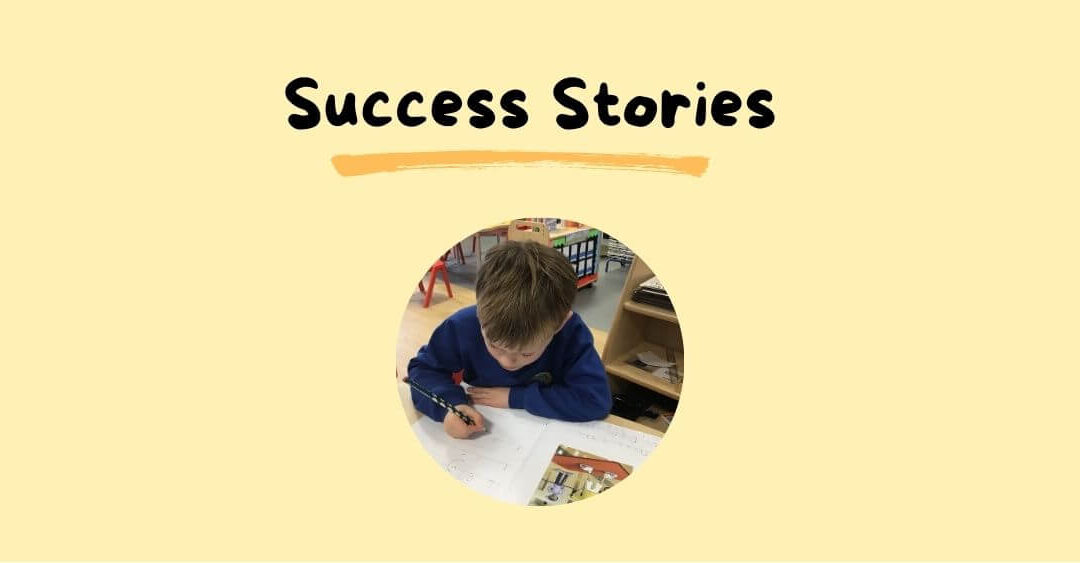
Toner Avenue School has achieved Silver School accreditation for their commitment to delivering high-quality phonics. Sophie Cox, Phonics Lead, tells us why they chose SoundsWrite and why it works so well for them.
Why did you choose Sounds-Write and how did you find the training?
We chose Sounds-Write because we liked the structure and how it was linked to research about cognition and working memory. It also worked well with our school ethos – all children must be part of the class and learning with their friends.

The consistency is very helpful if staff change year groups
– the scripts and thorough training mean they’re equipped to do this.
Sophie Cox, Phonics Lead
How do you implement Sounds-Write?
We implemented Sounds-Write in EYFS and KS1 immediately after the training. It is going really well; we’ve had numerous Ofsted visits and fidelity to Sounds-Write and matching decodable texts to students learning is always a strength. The consistency is very helpful if staff change year groups – the scripts and thorough training mean they’re equipped to do this. Sounds-Write is always updating resources and their Portal/membership website, which is so useful.
How have teachers and other staff found it?
Initially, staff were cautious and were worried that it didn’t have the ‘bells and whistles’ in comparison to other phonics schemes. However, when our Reception team had the majority of children writing dictated sentences in September, which had never happened with other schemes, they realised the impact of Sounds-Write and since then everyone has been fully on board.
How about children and parents?
Children enjoy their phonics lessons; the predictability reduces cognitive load so they can really focus on the sounds. We have ‘ mini Sounds-Write teachers ’ in Reception – they ’ ve memorised the script and, with their own little whiteboard, are often found ‘teaching ’ Sounds-Write and telling the others to ‘ say the sounds and read the word’ , marking their lines on for each sound too!
Parents love the parent course. We invite them into school as soon as Reception starts to teach them how to say the sounds correctly, and these sessions are always well attended. Later, we get them to join a phonics lesson to see how we learn in school, so they can continue to support at home. The feedback is always positive, and they wished they had learned to read this way!
What impact has it had on student learning and results?
All children make progress, but our results fluctuate and depend very much on cohort. We have some year groups that have 70 children, some that have 35. There is a refugee centre nearby, so we have children who come to our school for anything from a few weeks to a few months and then leave. And we also have above average number of children with significant SEND, some of whom can ’t access the tests.
What are the differences with other phonics schemes you’ve used previously?
The CPD is excellent and the fact it continues to be updated and offers so many additional courses is fantastic. The Portal and scripts make it so easy to teach, with less workload for staff. There’s a huge amount of ready-made resources to support children, particularly on the membership platform. We like that children are not removed from the group if they don’t know all their sounds, which can feel like being ‘ penalised’. They still take part in the class with their peers, using little tweaks to scaffold their learning. Then they can be supported with interventions outside of class to plug gaps.
Sounds-Write teaching is straight forward and the focus is the sound, not rhymes, not actions. In the past, some children were saying those rhymes instead of sounding out words! The gestures are excellent for supporting readers to blend, and the purposeful use of continuants is such a useful thing to support blending. The fact Sounds-Write teaches polysyllabic words is extra useful as that is a stumbling block for many schemes.
Any advice for those who are considering Sounds-Write?
Visit a school and see it in practice, as that really helped with our decision making. Once you’re committed to Sounds-Write, get on the portal and utilise the wealth of resources, videos and webinars, and join the Facebook group too, as it is so handy to chat with other practitioners.
You may also like
‘Sounds-Write is a long-term, strategic commitment’: Jaspreet Bansal, Eastbury Community School
For Eastbury Community School in East London, Sounds-Write has been transformational. Jaspreet Bansal, Associate Assistant Head and EYFS Phase Leader explains how it’s all down to robust and thoughtful implementation and sustaining high-quality delivery over time. We...
‘Children develop more independence as readers and writers’: Ellesha Gray, Woodham Academy
Woodham Academy is a mainstream secondary school that serves a diverse intake of students, many arriving in Year 7 with reading ages significantly below age-related expectations. We talked to Ellesha Gray, Literacy Coordinator, about how they’ve implemented...

‘No child leaves without being able to read’: St George’s C of E Primary School
At St George’s Primary School in London, literacy is ‘the heartbeat of the school’. For over a decade, Sounds-Write has been shaping teaching, leadership, outcomes and culture, explained Sarah Collymore, Headteacher, and Georgia Orchin, Deputy Headteacher.The school’s...
Discover Sounds-Write
Book a free consultation to discuss your individual training needs.