
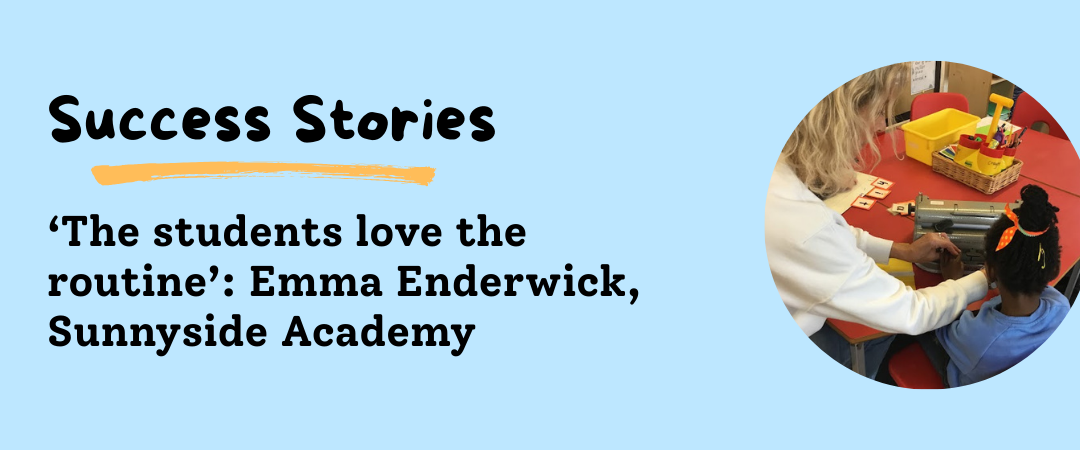
Emma Enderwick, Phonics and Early Reading Lead at Sunnyside Academy in Middlesbrough, has led the school’s implementation of Sounds-Write since 2018. With over twenty years of experience in Early Years education, she has helped embed an inclusive, consistent approach to phonics across the school.
Sunnyside Academy is a mainstream primary with specialist provisions for children with moderate learning difficulties, visual impairments, and deafness. Over a third of pupils have special educational needs and disabilities (SEND), and some children are bused in from neighbouring local authorities. The school’s mission statement—that all children have the right to achieve their full potential—shapes its commitment to inclusive teaching and learning.
Emma explained that standard phonics schemes used in the past were not robust enough, ‘Children were learning to read and write, but the knowledge didn’t seem to stick.’ In 2018, Sunnyside joined a local Sounds-Write pilot in Middlesbrough. After early success, the school trained all its teachers and teaching assistants, extending implementation yearly from Reception through to Year 6.

There’s nothing our SEND children can’t do as part of a Sounds-Write lesson. When everyone follows the same structure and language, every child can learn and every child can achieve.
Emma Enderwick, Phonics and Early Reading Lead
In the mainstream classes at Sunnyside, they adhere to Sounds-Write with complete fidelity, while making small, purposeful adaptations to make the learning accessible to students with individual needs. Lesson planning is shared weekly so that support staff can prepare adapted materials in advance, particularly for Braille resources. Support staff are fully on-board with the lessons and are well-prepared to be able to support children in whole-class lessons, even those with partial hearing.
In specialist bases, pupils with moderate learning difficulties are taught in smaller classes with higher adult ratios. Lessons may be broken into shorter parts and spread across the day to accommodate behaviour and concentration needs. ‘They might do the review in the morning, the current unit mid-morning, and the practice in connected text after lunch—but all three parts are always covered,’ Emma explains. ‘The simplicity and repetition of Sounds-Write are what make it so effective for these learners.’
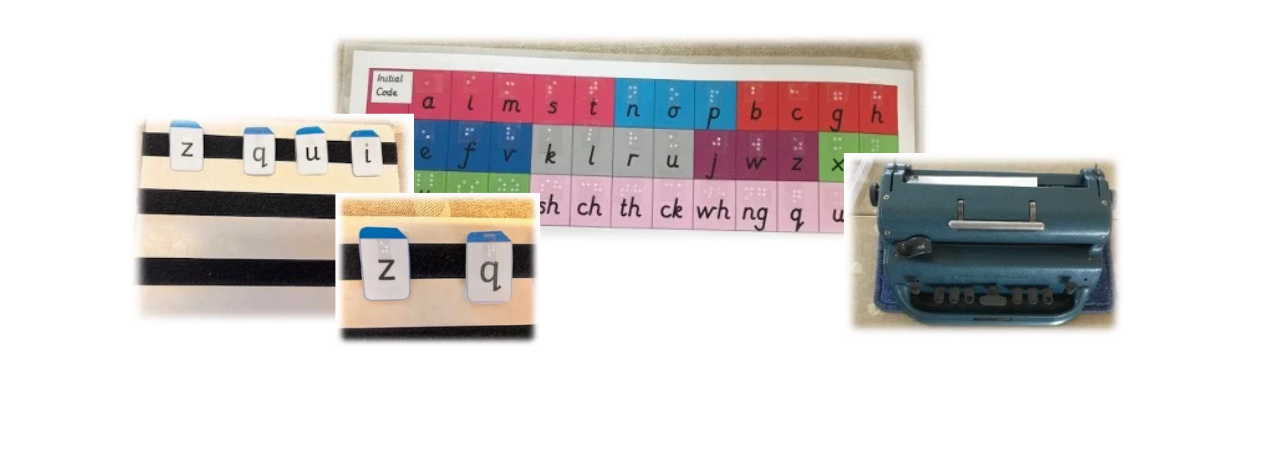
Visually impaired and blind students are fully integrated into mainstream lessons with teaching assistant support. To maintain lesson flow, teaching assistants quietly repeat the teacher’s script while students use pre-prepared Braille adaptations of grapheme cards, a Velcro working board for building words, and a Perkins Brailler for the writing parts of the lesson.
Your content goes here. Edit or remove this text inline or in the module Content settings. You can also style every aspect of this content in the module Design settings and even apply custom CSS to this text in the module Advanced settings.
Pre- and post-teach interventions are also used to reinforce specific knowledge for individuals or small groups. ‘Using the one-to-one reading time to focus on that specific child’s needs and really individualise the teaching for them is really valuable,’ Emma explains. ‘I have a whiteboard and a pen with me when I’ m listening to children read one-to-one. If a word comes up that they find difficult, I write it on the whiteboard for them and ask them to say the sounds and read the word and just give them the opportunity to succeed.’
Consistency extends beyond phonics. Staff use Sounds-Write language and error-correction scripts across the curriculum. ‘Even in maths, you might hear, “If that were five, it would look like this.” It’ s become part of how we talk about learning across all subjects.’
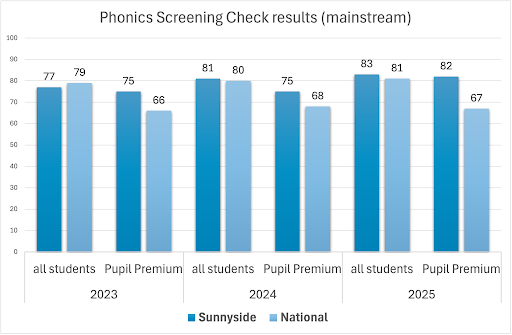
‘We have seen massive progress in reading and writing since we started using Sounds-Write and our PSC results have improved.’ And even where phonics screening results don ’t fully reflect it, teachers observe steady improvements in pupils’ reading and writing. ‘We know those children are learning to read and write—and it’s because of the beauty of Sounds-Write,’ adds Emma.
You may also like
Nursery children are ready for phonics at Weeting C of E Primary
At Weeting C of E Primary in Norfolk, phonics begins in nursery with a focus on developing children's phonological awareness and preparing them for formal reading and writing instruction. The school has used Sounds-Write from Reception to Year 6 since 2020, and...
‘Sounds-Write has been one of the most valuable developments we’ve made to our Early Years curriculum’ at Eastbury Community School
At Eastbury Community School in East London, Jaspreet Bansal, Associate Assistant Headteacher, EYFS Lead and Phonics Lead, explains how introducing Sounds-Write in Nursery has strengthened the foundations for early reading and created a more seamless transition into...
Orchards C of E Academy’s Phonics Screening Check results soared in just 3 years
At Orchards Church of England Academy in Wisbech, Cambridgeshire, Phonics Lead and Reception teacher Katie Crawley describes how the school has embedded Sounds-Write to support children with low literacy starting points. With 46% of pupils eligible for Pupil Premium,...
Discover Sounds-Write
Book a free consultation to discuss your individual training needs.