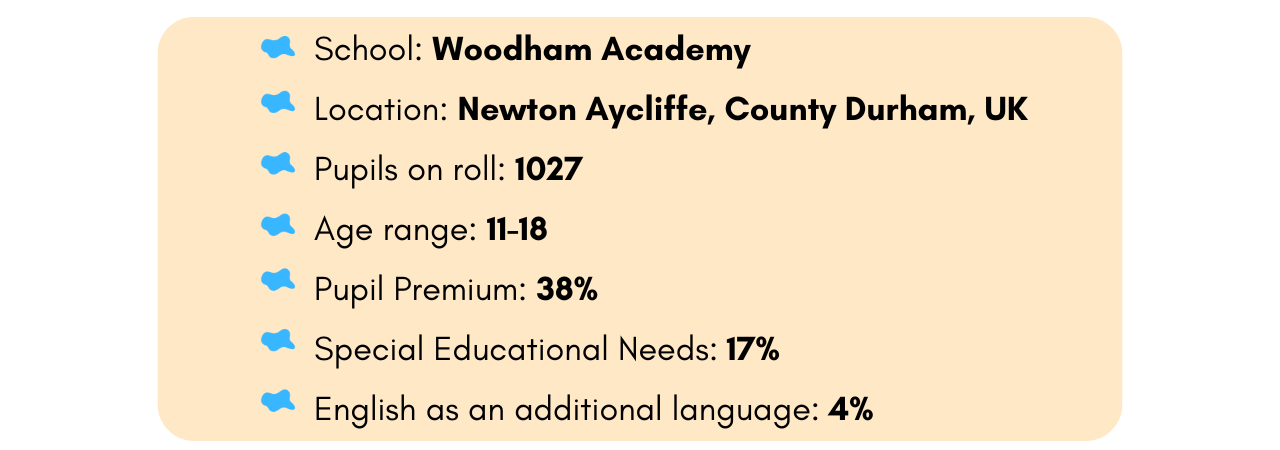
Woodham Academy is a mainstream secondary school that serves a diverse intake of students, many arriving in Year 7 with reading ages significantly below age-related expectations. We talked to Ellesha Gray, Literacy Coordinator, about how they’ve implemented Sounds-Write.
The school’s literacy team wanted a programme that provided precise instruction in phoneme–grapheme correspondence while being suitable for adolescents. After reviewing a range of phonics programmes, Sounds-Write was chosen because of its directness and clarity and because ‘it doesn’t patronise the students’, which is so important with older learners.
Training began in 2020–21 with a small cohort of LSAs and a HLTA, chosen for their capacity to deliver targeted interventions. The vision was to make phonics knowledge accessible across the school, not just in intervention spaces, so that a bit of phonics could be added in the moment when situations arose.

When the word ‘regicide’ comes up during Macbeth, we do some word analysis with the whole class, to get them thinking about the spelling but also looking at the meaning and the etymology.
Ellesha Gray, Literacy Coordinator
Woodham Academy has introduced Sounds-Write as a targeted intervention for non-readers and low-attaining readers in Years 7–9. Students are identified through KS2 and reading age data, and those with the most severe needs are allocated to Sounds-Write. These students receive sustained intervention until they have made sufficient progress. Other literacy interventions are in place for students who can decode but need help to improve fluency or comprehension.
Lessons take place in small groups or one-to-one, typically for one 50-minute weekly session. Crucially, learning support assistants are trained not only to deliver scheduled intervention but also to provide “in-the-moment” phonics correction and instruction in mainstream classrooms, using consistent language, whiteboards, and post-its.
Staff value the consistent terminology and instructional routines, and the clear lesson and error correction scripts, as they reduce teacher variation and increase student confidence. Over time staff have witnessed striking changes in confidence and independence.
The team prioritises consistency of delivery over quantity, ensuring each student receives high-quality instruction. Fidelity of implementation is maintained through ongoing training and internal coaching, and the school is now working to train more staff to address the capacity limitations of the core SEN department.
Students who cannot read often have problems with behaviour or low confidence. The explicit and highly structured nature of Sounds-Write helps reduce anxiety around reading. Teachers report that students value the predictable routine and immediate feedback in Sounds-Write lessons.
For some students, lessons are further adapted by breaking sessions into shorter segments or embedding additional repetition before moving to new content.
We have a ‘nurture’ group of Year 7 students with quite severe needs – gorgeous kids who really want to learn. They come out of some lessons with a trained Sounds-Write member of staff and get phonics, reading and dictation. And they’re really chuffed with their achievements.
Ellesha Gray, Literacy Coordinator
Woodham Academy’s experience demonstrates that systematic phonics, when delivered with precision and consistency, can close deep-seated reading gaps and transform educational trajectories — even in secondary settings.

You may also like

‘No child leaves without being able to read’: St George’s C of E Primary School
At St George’s Primary School in London, literacy is ‘the heartbeat of the school’. For over a decade, Sounds-Write has been shaping teaching, leadership, outcomes and culture, explained Sarah Collymore, Headteacher, and Georgia Orchin, Deputy Headteacher.The school’s...

‘Pupils have a sense of pride in their growing abilities’: Audrey Duffy, Waulud Primary School
Audrey Duffy, Phonics Lead at this two-form entry school in Luton, England, explains how, despite serving a community with above-average levels of Pupil Premium eligibility, Special Educational Needs, and pupils with English as an Additional Language, careful planning...

‘We have a school full of phonics experts’: Andrew Percival, Stanley Road Primary School
Andrew Percival, Deputy Headteacher at Stanley Road Primary, shared the impressive results achieved in an area of high social deprivation since the introduction of Sounds-Write. Why did you choose Sounds-Write? We first began hearing about Sounds-Write from school...
Discover Sounds-Write
Book a free consultation to discuss your individual training needs.