
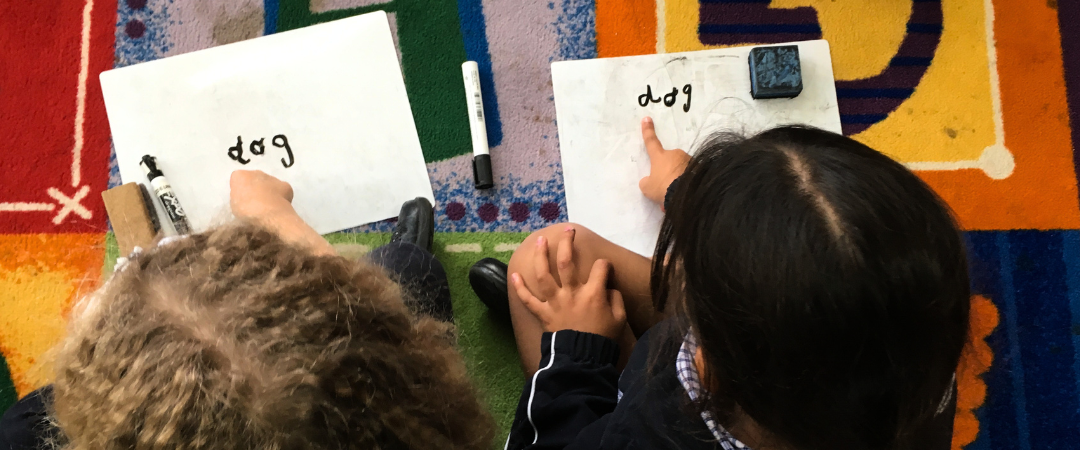
We’re often asked how best to organise classroom space when teaching Sounds-Write.
In Reception, we recommend that children sit on the floor with their whiteboards and markers at the ready for their Sounds-Write session. Older students can sit on the floor or at their table, whatever works best for you in your setting. As you probably know, we are firm advocates of children using mini-whiteboards. They help integrate the teaching of reading and writing, which should both happen at the same time, as reading and writing are two sides of the same coin. Whiteboards also play a crucial role in providing the teacher with the opportunity to offer immediate feedback through formative assessment, and to monitor what all students are writing on their individual board by asking them to ‘chin it’.
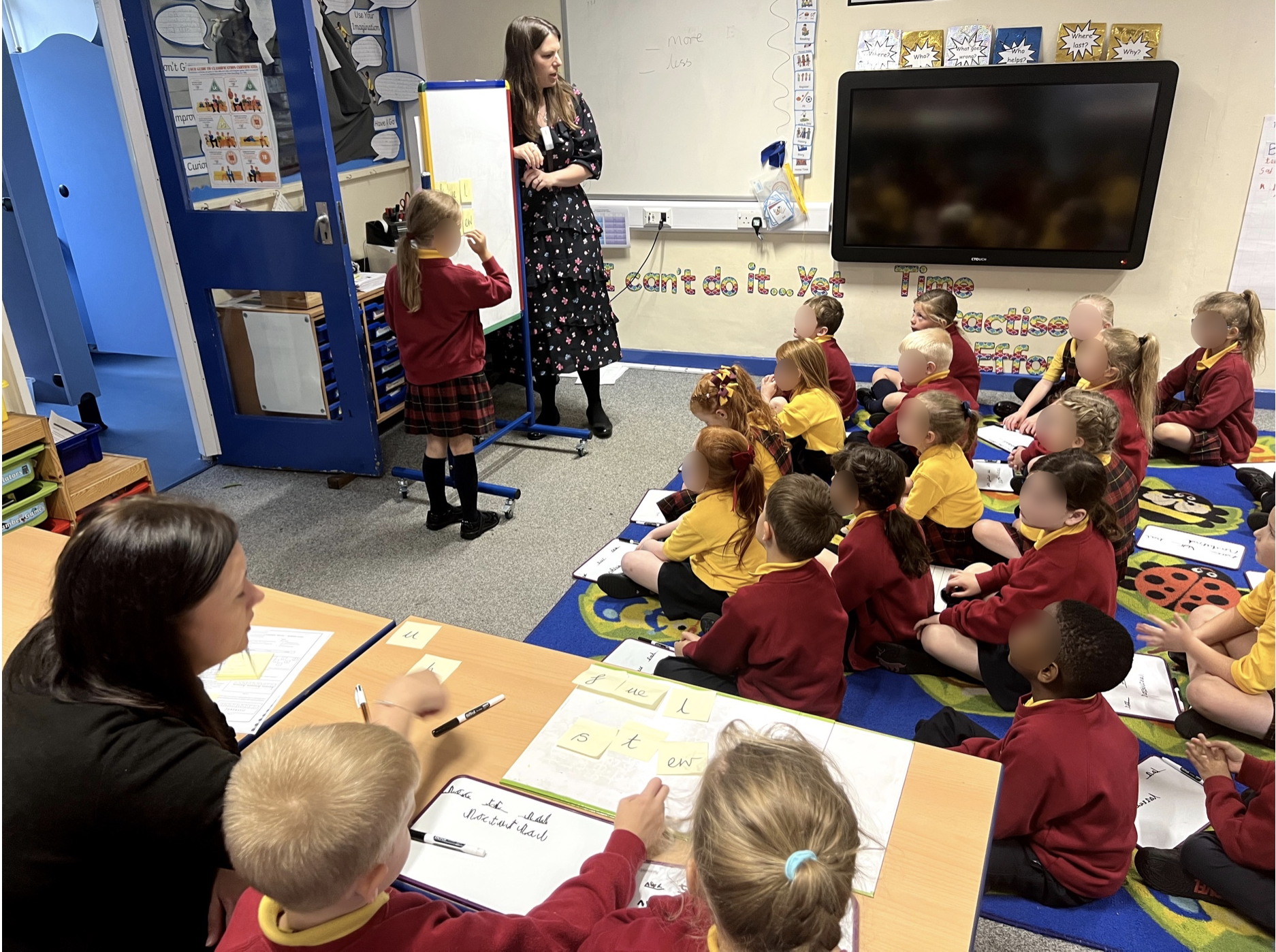
For children who need more support and who are working with a Teaching Assistant, we strongly recommend that the TA works with them at a separate table, mirroring exactly what the teacher is doing with the rest of the class to help them keep up. This enables those children who need extra support to take part in all the activities, word building, reading and writing every word that their peers are working on with the class teacher. At the same time, these students have access to a dedicated, trained practitioner who is able to offer the right help and support precisely in the moment it’s needed through the use of our careful scaffolding techniques. And it is this supported, deliberate practice that is going to enable these students to keep up. Although it requires the teacher to share their planning with the TA at the start of the session and a little preparation in terms of getting the relevant sound tiles ready, we strongly believe this setup maximises the support the students get, so it’s really worth it.
We were lucky enough to visit the wonderful Chorley St James Primary School in Lancashire the other week, and that’s exactly how they set up their classrooms. Here’s their Y2 class working on different spellings of the sounds /ue/. Whilst the teacher is working with the whole class and leading the session, the TA is supporting two students do the same work in parallel, so they can both be part of the session and get additional support and practice to help them succeed.
If you have a Sounds-Write-trained TA working with you in your classroom, why don’t you try to set up your classroom this way and give it a go for a few weeks, and let us know how you’re getting on?
You may also like
Allied Health Partnerships highlights the impact of Sounds-Write for linguistically diverse students
In addition to providing Sounds-Write training to professionals, Allied Health Partnerships has developed a school-based intervention model that combines speech pathology expertise with Sounds-Write. Its speech pathologists provide targeted literacy support for...
‘Sounds-Write is a long-term, strategic commitment’: Jaspreet Bansal, Eastbury Community School
For Eastbury Community School in East London, Sounds-Write has been transformational. Jaspreet Bansal, Associate Assistant Head and EYFS Phase Leader explains how it’s all down to robust and thoughtful implementation and sustaining high-quality delivery over time. We...

‘Children develop more independence as readers and writers’: Ellesha Gray, Woodham Academy
Woodham Academy is a mainstream secondary school that serves a diverse intake of students, many arriving in Year 7 with reading ages significantly below age-related expectations. We talked to Ellesha Gray, Literacy Coordinator, about how they’ve implemented...