
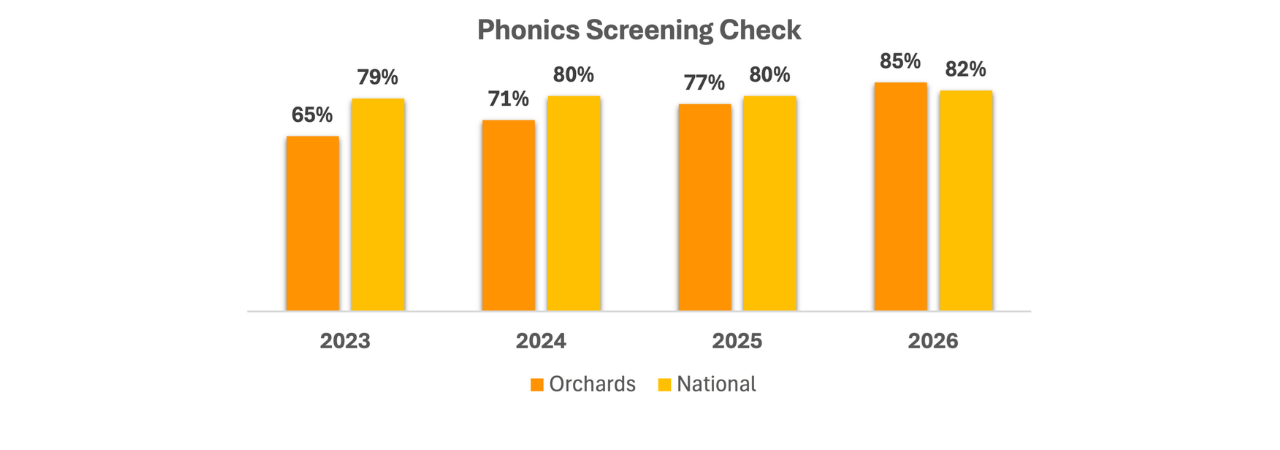
Orchards C of E Academy's Phonics Screening Check results soared in just 3 years
At Orchards Church of England Academy in Wisbech, Cambridgeshire, Phonics Lead and Reception teacher Katie Crawley describes how the school has embedded Sounds-Write to support children with low literacy starting points. With 46% of pupils eligible for Pupil Premium, 23% with SEND and 45% speaking English as an additional language, the school places a strong emphasis on speaking and listening alongside systematic phonics. Sounds-Write was introduced gradually, beginning with senior leaders and prioritising Reception and Year 1, supported by whole-school CPD and instructional coaching. Staff initially had some reservations about the scripted approach, but confidence grew as they saw pupils respond to the routines and make progress. The school reports increasing Phonics Screening Check scores, strong application of phonics skills across the curriculum, and confident, engaged children who increasingly apply their knowledge to reading and spelling.
School: Orchards C of E Academy
Location: Wisbech, Cambridgeshire, UK
Pupils on roll: 395
Age range: 2-11
Pupil Premium: 46%
Special Educational Needs: 23%
English as an additional language: 45%
It is easy to think you know the script really well, but at times when I’ve recorded my lesson and watched it back, I’ve missed out key parts or added extra detail.
My advice is to work collaboratively with others to develop best practice, and that’s why we’ve used instructional coaching with all staff across the school.
Why did you choose Sounds-Write and how did you implement it?
Many children enter our school with low literacy levels, so we really focus on speaking and listening, and Sounds-Write’s sound to print approach really supports that.
We implemented Sounds-Write gradually, starting with senior leaders, because they need to understand the programme to support staff, then teachers and teaching assistants, prioritising Reception and Year 1. I led whole-school CPD on the principles of Sounds-Write, why it was the best bet for our children and how it would support teachers to develop their subject knowledge.
How have teachers found using Sounds-Write?
We had used a variety of phonics programmes, so when we began implementing Sounds-Write, some staff were apprehensive about using scripts and teaching a wider range of code. However, as they observed the progress being made, and saw how quickly both children and staff adapted to the routines, it became clear that Sounds-Write was the most effective approach for our pupils. High levels of fidelity to the script mean that lesson delivery is highly effective. Adults can develop their skills by observing strong practice from colleagues and reflecting on their own practice.
We have the Sounds-Write Membership, which allows staff to access the training when it is best for our school. We can also choose the best pathway for them, according to their role within school.
What impact has Sounds-Write had on student learning?
The impact has been huge on children across school. In daily reading and writing lessons, children apply what has been taught in their Sounds-Write lessons and the skills and phrases are used across the curriculum. For example, when writing in geography, the same approach is used to support children with their writing and spelling as would be used in a Sounds-Write lesson, ensuring consistency.
Our Phonics Screening Check scores are increasing year on year and whilst we still have progress to make, we have an embedded approach to ensure this upwards trajectory continues.
How have children and parents found Sounds-Write?
Children enjoy Sounds-Write lessons, they enjoy the routine and you will often hear children say key parts of the scripts during the lessons, such as ‘they all sound the same, but they are all spelt differently!’ In EYFS, children will often re-create a Sounds-Write lesson as part of their continuous provision. The active engagement of all pupils in the lesson is very noticeable when compared to other approaches of teaching phonics and early reading.
Parents comment on the accelerated progress that their children make with reading, especially in EYFS and KS1.
How is it different from other phonics schemes you’ve used in the past?
Other phonics schemes did not have such a focus on phoneme manipulation, which is such an important skill to learn to read. With Sounds-Write, the children quickly understand the lesson structure and aren’t distracted by rhymes or actions. They are highly engaged and motivated in the lessons because they experience success, rather than enjoying the props or other potential distractions.
Other schemes do not teach children the wide range of code, and this has supported spelling into KS2. In previous schemes, children in Reception would have learnt more sounds, but by ensuring they are secure reading more complex word structures by the end of Reception, they are now far more confident and in a better position to start learning the Extended Code in Year 1.